Nairobi did not simply host a fashion week — it declared itself a fashion capital. Under the banner Decarbonize, Nairobi Fashion Week 2026 positioned the city at the center of a continental conversation and quietly inserted it into the rhythm of the global fashion calendar. For four days, sustainability, heritage, and commerce aligned with unusual clarity, presenting Nairobi not as an emerging scene, but as an authoritative voice shaping the future of fashion.
The opening launch at Matteo’s Restaurant in Karen served as an intentional prelude — intimate, focused, anticipatory. It gathered designers and industry leaders in a space that felt less celebratory and more strategic: a shared understanding that the week ahead would articulate a new framework for African fashion. The following day’s curated Fashion Pop-Up Market extended that vision into commerce, connecting designers directly with retailers and reinforcing fashion as infrastructure rather than spectacle.
Across January 29th and 30th, Thread Talks, held at The Social House Nairobi, became the intellectual spine of the week. Conversations examined how Africa can decarbonize its fashion supply chain fairly, reframing sustainability as systems thinking instead of seasonal trend. Representatives from UNEP, Gatsby, the Kenya Fashion Council, and veteran designers debated production ethics, circular economies, and the realities of scaling African fashion globally without repeating extractive models. A designer masterclass powered by Anansi translated theory into practice, equipping creatives with tools to build brands that are both responsible and internationally competitive.
By the time the runway opened on January 31st at the Sarit Expo Centre, the audience understood the show as the culmination of an argument: fashion as policy, craft as activism, and Nairobi as a city writing its own terms of relevance.
The Designers Who Defined the Moment
The evening found its gravitational center in John Kaveke, the seasoned Kenyan menswear statesman whose return to the runway carried ceremonial weight. His collection staged a dialogue between Maasai heritage and Japanese precision. Structured tailoring met ceremonial fluidity; disciplined silhouettes softened through cultural symbolism. The garments felt architectural yet deeply human, an intercontinental exchange rendered in cloth. Kaveke did not quote tradition; he translated it, reaffirming his status as one of East Africa’s most intellectually rigorous designers.
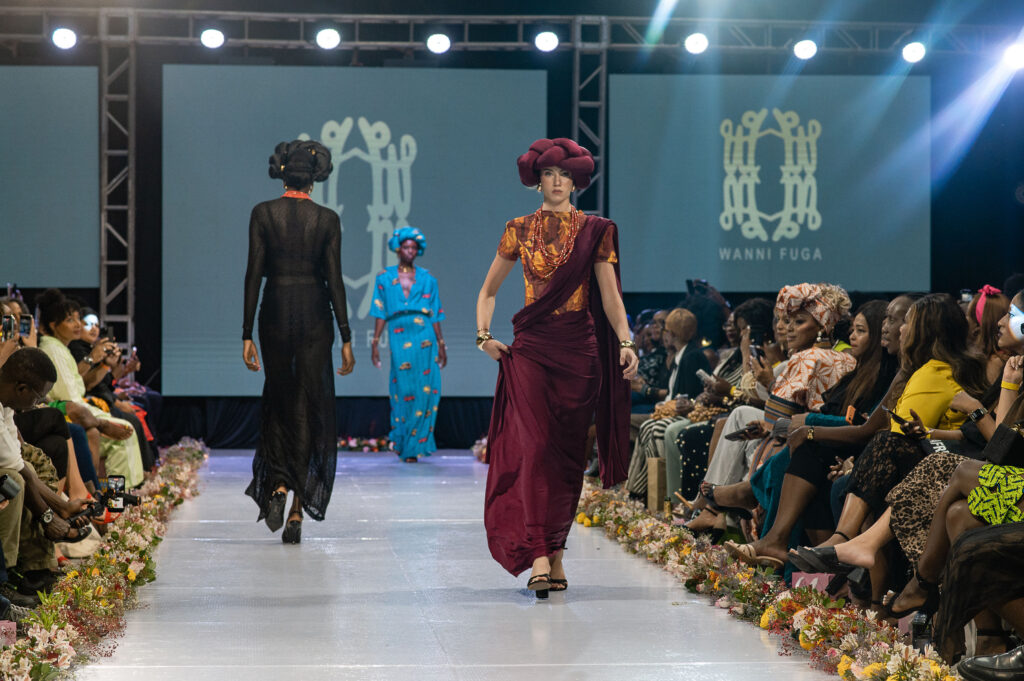
Nigerian luxury house Wanni Fuga followed with a study in controlled power. Clean lines, sculptural silhouettes, and impeccable tailoring articulated a vision of modern African elegance that felt globally fluent. There was restraint in the palette and authority in the cut clothing designed not to shout but to command space. Each piece elevated the runway into quiet theatre.
Read Also: The Sh10.8B Red Flag: Talanta Sports City Cost Soars Past Treasury Limits
Yevaàna offered a tactile counterpoint. Constructed from cotton, linen, and hemp and shaped through deliberate handcraft, her collection transformed sustainability into sensual experience. The garments celebrated slowness textured, sculptural, and intimate. Rather than preaching environmentalism, Yevaàna embodied it, turning the Decarbonize theme into wearable poetry.
Expanding the Visual Vocabulary
Among the strongest circular statements came from Rialto, led by Lucy Rao, a pillar of Nairobi’s premium atelier culture. Her upcycled denim collection reimagined familiar material into sharp, architectural tailoring, proving that sustainability can operate at couture levels of discipline and luxury.
Vast Made by Africa delivered silhouettes rooted in continental optimism — clothing designed for movement, identity, and forward momentum. The collection carried an expansive energy, projecting African futurism with confidence.
Studio Lola approached the runway with artisanal restraint, exploring minimalism through precision construction.
Naaniya, a French-born designer of Malian descent, layered Bogolan textiles into contemporary European silhouettes, merging heritage craft with refined tailoring and positioning tradition as living material rather than relic.
ACI NOD, the American streetwear label, injected urban cadence into the lineup, expanding the show’s vocabulary beyond couture and grounding the conversation in youth culture and accessibility.
Read Also: Tokyo in Nairobi? Kenya Turns to Japanese Expertise to Transform Urban Traffic
Kenyan contemporary brand Kitukizo, inspired by Swahili heritage, offered coastal elegance through fluid silhouettes that suggested architecture and sea air. A Touch of Kenya showcased bespoke leather fused with intricate beadwork, demonstrating how ancestral techniques evolve into modern luxury.
Experimental label Molivian pushed texture and proportion into conceptual territory, widening the aesthetic spectrum and underscoring Nairobi’s appetite for creative risk.
Fashion as Social Architecture
Sustainability extended beyond materials into community impact. Maisha, based in Elementary Theatre, transformed second-hand textiles into socially driven collections tied to empowerment programs, proving circular fashion can function as economic architecture.
Meanwhile, Afro Street Kollektions, led by Yvonne Odhiambo, anchored the urban narrative with versatile streetwear that captured the rhythm of contemporary African city life, adaptable, confident, and culturally fluent.
A City Cementing its Authority
Read Also: Retirees Warn Young Kenyan Workers: Don’t Wait Until Retirement to Build Your Home
Nairobi Fashion Week 2026 did more than stage a successful event. It shifted perception. By centering decarbonization without sacrificing artistry, the week positioned Nairobi as a capital of forward-thinking design, a city capable of setting agendas rather than following them.
Fashion here was not spectacle alone. It was infrastructure. It was policy. It was identity articulated through cloth. In claiming sustainability as its language and heritage as its foundation, Nairobi did not ask for a seat at the global table. It built its own.
For business enquiries, reach out to us via benson.kiragu@capitalfm.co.ke
The post Nairobi Fashion Week: The Decarbonize Edition That Cemented the City on the Global Fashion Calendar appeared first on Capital Lifestyle.
Read more at original source.