
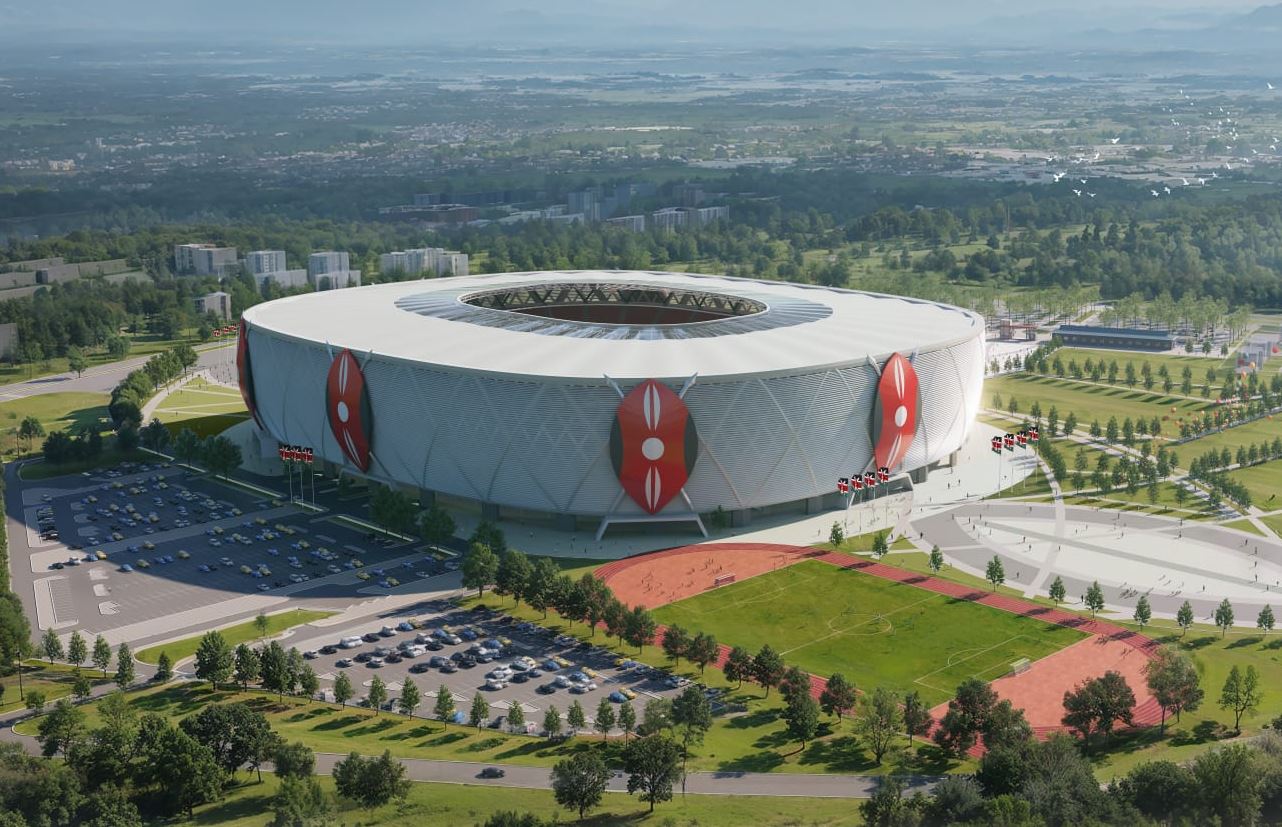
The cost of building Nairobi’s Talanta Sports City has surged by Sh10.85 billion above the Treasury’s initial approval, according to a damning new report from Auditor General Nancy Gathungu.
The audit blames unexplained price hikes and a procurement process that bypassed legal requirements, raising serious questions about transparency and financial oversight in the high-profile project.
Budget Approved vs. Contracted Cost
Gathungu’s review of the Ministry of Defense accounts for the 2024/25 financial year shows that the National Treasury originally cleared Sh35 billion for the stadium. The plan involved drawing the funds from the Sports and Arts Social Development Fund (SASDF) over six years.
Despite this, the final contract to design, build, and equip the 60,000-seat arena stands at Sh45.85 billion, creating an unexplained Sh10.85 billion gap.
“This is against a contract amount of Sh45.85 billion, resulting in an unsupported price variation of Sh10.85 billion,” the report reads.
The Ministry of Defense signed a two-year deal with a foreign contractor on May 26, 2024, worth Sh45,848,051,675 (approximately US$344.5 million). Kenya plans to use the stadium as a key venue for the 2027 Africa Cup of Nations.
Read Also: Tokyo in Nairobi? Kenya Turns to Japanese Expertise to Transform Urban Traffic
Legal Breaches in Procurement
The audit found the ministry did not obtain the attorney general’s clearance before awarding the contract, a serious violation of government procedures.
“Clearance from the Attorney General for the award of the contract was not provided for audit,” the report states.
Justin Muturi served as Attorney General during that period. Under Section 134 of the Public Procurement and Asset Disposal Act, any contract exceeding Sh5 billion must receive AG approval before signing. Cabinet Secretaries are also required to report large contracts to both the Cabinet and the National Treasury.
Before the contract was signed, the Ministry of Sports, Culture, and Social Services handed over procurement duties and Sh2.01 billion to the Ministry of Defense. The audit also flagged that officials used direct procurement to award the contract, bypassing competitive bidding standards outlined in the Public Procurement and Asset Disposal Act of 2015.
“The contract was awarded through a direct procurement method which did not meet competitive procurement and direct procurement criteria demanded by the Public Procurement and Asset Disposal Act of 2015,” the report reads.
Open tendering is the standard method for government procurement, and direct procurement is allowed only under exceptional circumstances such as exclusive rights, emergencies, or disasters, none of which applied here.
Read Also: Retirees Warn Young Kenyan Workers: Don’t Wait Until Retirement to Build Your Home
Project Progress and Payment Risks
By June 1, 2025, the stadium had reached 44.54 percent completion, with 15 months remaining. So far, the government has paid the contractor Sh2 billion, about 4.5 percent of the total contract value.
The audit warns that delayed payments could trigger hefty penalties. The contract includes a clause charging interest at 3 percent above the Central Bank of Kenya’s average lending rate for overdue amounts.
“However, late payments will attract an interest at 3% (above the Central Bank of Kenya average rate for base lending prevailing as of the first day the payments become overdue) in accordance with Article 3.5 of the contract agreement, resulting in additional avoidable project expenditure,” the report reads.
Auditors also flagged gaps in the financial structure, noting that critical details of the revised funding model are missing.
“Similarly, the contractor signed a consent agreeing to the transfer of duty and obligation of making subsequent payments to the Trustee on behalf of the Ministry of Defence. The changes in the funding model were aimed at ensuring that the project was fully funded to completion. However, full details of the new funding model have not been provided, hence the need for a special audit to determine value for money in the achievement of the project,” the report states.
The Talanta Sports City is funded through a bond listed on the Nairobi Securities Exchange (NSE), with the SASDF servicing payments of approximately Sh3.4 billion every six months. On July 22, 2025, Defense Principal Secretary Patrick Mariru and Sports Kenya signed an agreement with a trustee to manage future payment obligations.
Read Also: StarTimes Brings Football’s Fiercest Rivalry to Screens as Bayern Face Dortmund
The Cost in Perspective
To illustrate the Sh10.85 billion overrun, the money could have funded 9.5 kilometers of the Rironi–Mau Summit dual carriageway. Alternatively, it could cover a full year of education for 4.8 million primary school students or support nearly half a million secondary school learners.
As Kenya moves closer to hosting the 2027 Africa Cup of Nations, the auditor general’s report signals urgent questions about accountability, transparency, and financial management in one of President William Ruto’s most ambitious sports infrastructure projects.
Facebook Twitter WhatsApp TelegramThe post The Sh10.8B Red Flag: Talanta Sports City Cost Soars Past Treasury Limits appeared first on Nairobi Wire.
Read more at original source.